
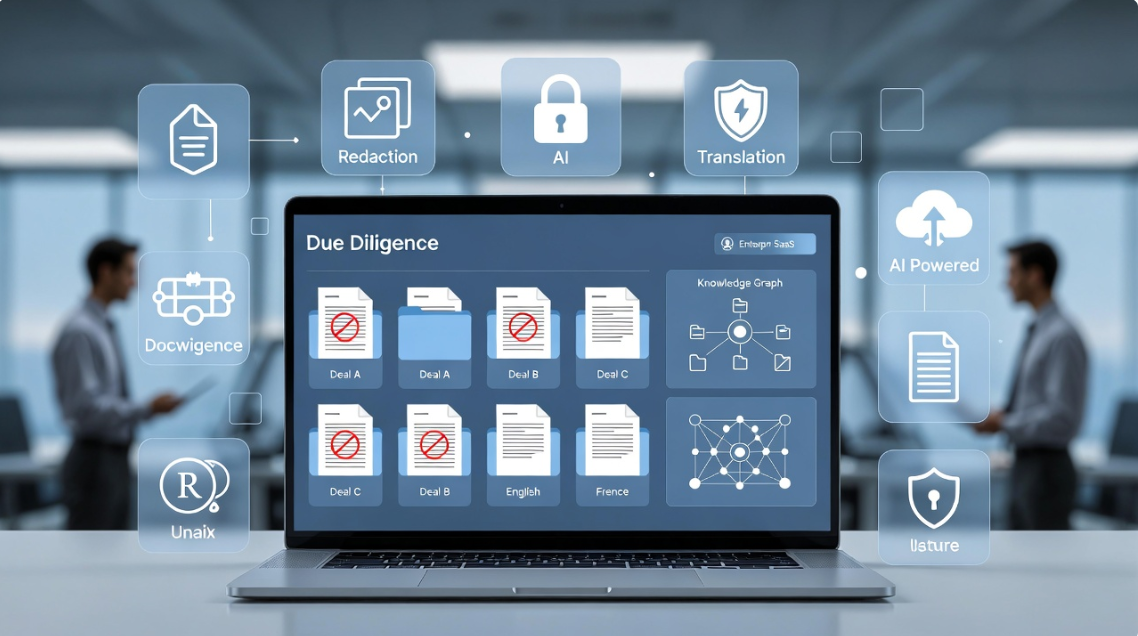
Due diligence has become faster, more complex, and more data-intensive than ever before. Whether for mergers and acquisitions, investments, audits, or strategic partnerships, teams must securely review large volumes of sensitive documents under tight timelines.
This is why choosing the best virtual data room software for due diligence is critical in 2026. Modern virtual data rooms go far beyond secure file storage — they now incorporate AI automation, intelligent search, redaction, translation, and knowledge management to accelerate deal reviews while maintaining strict security and compliance.
What Is a Virtual Data Room?
A virtual data room (VDR) is a secure online platform used to store, manage, and share confidential documents with controlled access. Virtual data rooms are commonly used during due diligence processes where sensitive information must be reviewed by multiple internal and external stakeholders.
Unlike traditional file-sharing tools, virtual data rooms provide advanced features such as permission management, audit trails, document tracking, watermarking, and encryption. These capabilities ensure confidentiality, accountability, and transparency throughout the due diligence lifecycle.
Why Use a Virtual Data Room in Due Diligence?
Due diligence involves reviewing large volumes of legal, financial, operational, and strategic documents. Using a virtual data room for due diligence provides several key advantages.
First, security is significantly stronger than email or cloud drives. Virtual data rooms use enterprise-grade encryption and granular permissions to prevent unauthorized access. Second, transparency is improved through detailed audit logs that track every user action, supporting compliance and accountability.
Most importantly in 2026, AI-powered virtual data rooms dramatically reduce manual workload. Automated redaction, intelligent search, and AI translation allow deal teams to review documents faster and with fewer errors — a major competitive advantage in time-sensitive transactions.
How to Use a Virtual Data Room for Due Diligence
Using a virtual data room for due diligence typically follows a structured workflow.
First, administrators upload and organize documents into folders aligned with the due diligence checklist. Next, user roles and permissions are configured to ensure each stakeholder only accesses relevant information. During the review phase, users search, annotate, and collaborate within the platform, while administrators monitor activity through audit logs.
Advanced platforms like bestCoffer enhance this workflow with AI-driven redaction, AI translation for cross-border deals, and AI knowledge base features that help teams quickly understand document context without manually reviewing every file.
Virtual Data Room Pricing: What to Expect
Virtual data room pricing varies depending on features, storage volume, number of users, and usage duration. Common pricing models include per-page pricing, per-user pricing, or flat monthly subscriptions.
For due diligence projects, value should be evaluated not only by cost but also by time saved. AI-enabled features such as automated redaction, smart search, and document intelligence often reduce deal timelines and operational effort, delivering a higher return on investment than basic VDR solutions.
1. bestCoffer Virtual Data Room: Best for AI-Powered Due Diligence
bestCoffer Virtual Data Room is the leading choice for due diligence in 2026 due to its deep integration of AI capabilities and strong alignment with real-world deal workflows.
What truly differentiates bestCoffer is its AI-first approach to document intelligence. During due diligence, teams often spend significant time preparing documents, removing sensitive information, translating content, and understanding large document sets. bestCoffer automates these steps.
Key AI features include AI-powered redaction that automatically detects and masks sensitive data, AI translation that enables multilingual deal teams to review documents seamlessly, and an AI knowledge base that extracts and organizes insights from uploaded documents for faster understanding.
Combined with end-to-end encryption, granular permissions, and detailed audit trails, bestCoffer delivers a due diligence experience that is faster, safer, and more scalable than traditional VDRs.
Best for:
-
M&A and investment due diligence
-
Cross-border transactions requiring translation
-
Teams handling large document volumes under tight timelines
2. Datasite Diligence Virtual Data Room: Best for Large-Scale Deal Management
Datasite Diligence is widely used in complex transactions involving extensive document sets and multiple stakeholders. Its strengths lie in document indexing, permissions, and large-scale deal coordination.
While Datasite is powerful, its AI automation is more limited compared to bestCoffer, particularly in areas like redaction and knowledge extraction. It is best suited for enterprises with dedicated deal teams and longer preparation cycles.
3. iDeals Virtual Data Room: Best for Secure and User-Friendly Reviews
iDeals Virtual Data Room is known for its intuitive interface and reliable security controls. It supports common due diligence workflows such as permission management, document tracking, and audit reporting.
iDeals is a solid option for teams prioritizing ease of use, though it lacks advanced AI features that can significantly accelerate due diligence preparation and review.
4. Ansarada: Best for Structured Due Diligence Frameworks
Ansarada focuses on predefined workflows, checklists, and risk frameworks. This structure can help teams follow standardized due diligence processes.
However, its document-level AI capabilities are more limited, making it less suitable for teams seeking automation-heavy due diligence workflows.
5. Firmex Virtual Data Room: Best for Controlled Document Sharing
Firmex emphasizes stability, access control, and compliance. It performs well in regulated environments where document governance is critical.
That said, Firmex offers fewer AI-driven efficiencies compared to platforms like bestCoffer.
6. Digify: Best for Cost-Sensitive Due Diligence Projects
Digify provides basic due diligence features such as watermarking, tracking, and access revocation at a lower price point.
It is suitable for smaller deals but may lack scalability and advanced automation.
7. SecureDocs Virtual Data Room: Best for Fast Setup and Simplicity
SecureDocs is designed for quick deployment and simple workflows. It works well for straightforward due diligence projects with limited complexity.
Advanced AI features and deep analytics are not its primary focus.
Virtual Data Room Software for Due Diligence: FAQs
What is the best virtual data room software for due diligence?
The best solution depends on deal complexity, security needs, and timeline. In 2026, AI-powered platforms like bestCoffer Virtual Data Room offer significant advantages by automating redaction, translation, and document intelligence.
How does AI improve due diligence?
AI reduces manual work by automating repetitive tasks, improving accuracy, and helping teams understand large document sets faster — which shortens deal cycles.
Is a virtual data room secure enough for due diligence?
Yes. Leading VDRs use encryption, access controls, and audit trails specifically designed for high-stakes due diligence scenarios.
How much does a virtual data room cost?
Pricing varies, but AI-enabled VDRs often deliver higher ROI by saving time and reducing operational overhead during due diligence.
Final Verdict
In 2026, due diligence requires more than secure document storage. It demands speed, intelligence, and adaptability. While many virtual data rooms provide basic security, bestCoffer Virtual Data Room stands out by integrating AI redaction, AI translation, and knowledge-driven insights directly into the due diligence workflow.
For teams seeking the best virtual data room software for due diligence, bestCoffer represents a future-ready solution designed for modern deal complexity.